Buying guide for best flood lights
Ready to buy now? Shop the best:
Outdoor security lighting has become easier to install and more energy-efficient in recent years, thanks to brighter LEDs, smarter motion sensors and reliable solar charging.
Whether you want to illuminate a walkway, add visibility for pets at night or discourage trespassers around your home, choosing the right flood light can make a clear difference in how well an area stays lit and how often you need to maintain the system. The challenge is sorting through options that vary widely in brightness, detection range, battery life and durability once they are exposed to weather.
This guide highlights several top performers to help you compare what actually works in everyday use. We've included practical notes on installation, real-world reliability and any tradeoffs you should expect, so you can select a light that fits your space without guesswork. Our favorite is the Tzumi Motion Sensor Solar Flood Lights.
Editors' Picks
Brightness: 7000 lm | Wattage & Energy Efficiency: Solar-powered; 1W LED with 1200mAh rechargeable battery | Motion Sensor: Built-in motion sensor with three adjustable lighting modes
The Tzumi Motion Sensor Solar Flood Lights package includes everything to get them on a wall or fence, and the wireless remote plus three adjustable modes make it easy to tailor the output to your situation.
The motion sensor is responsive and the lights throw enough illumination to comfortably light a small area or pathway. On top of that, the 1200mAh solar battery usually holds through the night after a good day of sun.
For those looking to avoid wiring and keep electricity bills down, the solar power and low 1-watt draw are definite wins, and the IP44 rating gives reasonable peace of mind against rain and splashes. However, several customers report that these flood lights are noticeably dimmer than advertised.
Still, if you want an affordable, easy-to-install solution to brighten small areas and prioritize convenience and energy savings, these are your best bet.
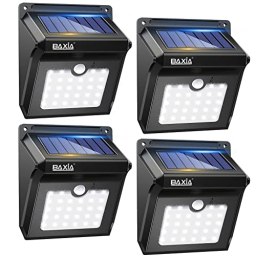
Brightness: 400 lumens | Wattage & Energy Efficiency: 1.3 W; solar-powered, energy-saving | Motion Sensor: PIR motion sensor, detects motion within 10'–16' at a 120-degree angle
The Baxia Technology Solar Outdoor Lights feature a 400-lumen output combined with a sensitive PIR sensor, making them great for lighting steps, a garage entry or a short stretch of fence.
The cold, white LEDs give a crisp, security-style illumination that wakes up instantly when motion is detected (the “No‑Dim” behavior means full brightness as soon as they're triggered). Installation is straightforward; wall screws or tape and the compact ABS housing with an IP65 rating feels solid enough to stand up to rain and wind.
That said, there are some notable drawbacks, primarily with long-term reliability. For the price and convenience, though, these lights offer strong value for anyone wanting an easy, wire-free security boost around a yard or doors.
Brightness: 4200 lumens | Wattage & Energy Efficiency: 38 W | Motion Sensor: Motion-activated (humans/cars/animals), up to 72' range, 180° detection angle
With 4,200 lumens at just 38 watts and a bright 5,500 Kelvin daylight color, the LEPOWER LED Motion Sensor Security Lights provide usable, stark illumination that can literally make a dark driveway or porch feel like daytime.
The three adjustable heads and optical filter lens aim coverage where it’s needed, and the metal body feels sturdy with good heat dissipation. Installation is straightforward for anyone comfortable with basic wiring.
LEPOWER claims over 80% savings versus a comparable 175-watt traditional light, which is meaningful if you’re trying to cut operating costs. However, you should be aware that there are numerous complaints about the motion detection being unreliable or inconsistent.
But overall, if your priority is bright, durable, energy-efficient outdoor security lighting at a very reasonable price, this is a solid pick; just plan on fine-tuning the sensor placement for the best results.
Understanding Flood Light Specifications
Flood lights look simple on the surface, but the spec sheet is where you learn what you are really buying. When you know what the numbers mean, it gets easier to match a fixture to a backyard, driveway, storefront or work area.
Brightness (Lumens)
Lumens describe total light output. Higher lumens means a brighter light.
Start by thinking about the size of the space and what you want the light to do. A small backyard usually needs less output than a large commercial area, and “bright enough” for casual use is different from “bright enough” for security or task lighting.
Energy efficiency
Energy efficiency comes down to how much light you get for the power you use. LED flood lights lead the pack here.
Because LEDs consume less power, they can help reduce electricity use compared with less efficient lighting. That can translate to lower electricity bills, and it is also a plus from an environmental standpoint.
Color temperature (Kelvin)
Color temperature is measured in Kelvin (K), and it affects how the light feels and how clearly you can see details.
-
Warm light (around 2700K) tends to create a cozier ambiance.
-
Cool light (around 5000K) is often a better fit when you want crisp visibility, like in security-focused areas.
Durability and Weather Resistance
Outdoor lighting has a harder job than indoor fixtures. It has to deal with water, dust, temperature swings and constant exposure. Durability is not a “nice to have” feature; it is part of whether the light will hold up long-term.
Material quality
Pay attention to what the housing is made of. Sturdy materials like aluminum or high-grade plastic are commonly used for outdoor flood lights because they can handle wear and tear better than cheap, brittle materials.
Ingress Protection (IP) ratings
IP ratings tell you how well a light resists dust and water. For outdoor flood lights, a practical target is IP65 or higher for reliable performance outside.
Weather resistance
Rain is the obvious concern, but weather resistance also includes snow, heat and the day-to-night cycle that expands and contracts materials over time.
How We Analyzed
We focused on flood lights that fit common needs like lighting walkways, improving visibility for pets at night, and adding security coverage around a home.
To choose our top picks, we compared models using a consistent set of criteria based on manufacturer specs and buyer-facing details:
-
Brightness and practicality: stated lumens and how that output typically fits small vs. large areas, plus common “dimmer than expected” complaints.
-
Motion detection: detection range, detection angle and whether the light activates at full brightness.
-
Power and efficiency: solar vs. wired, battery capacity for solar units and output per watt for wired models.
-
Weather readiness: housing materials and IP ratings to gauge durability outdoors.
-
Coverage control: adjustability, head positioning and how well the design supports focused vs. wide coverage.
-
Setup and usability: mounting simplicity, included hardware, and helpful extras like modes or remotes.
-
Overall value: performance and features weighed against price.
FAQ
Q. How many lumens do I need for a flood light?
A. It depends on the size of the area and your goal. Smaller spaces like patios or small backyards need less brightness than large driveways, parking lots, or commercial areas. Use lumens as your baseline for “how bright,” then fine-tune with beam angle and mounting height.
Q. Are LED flood lights worth it compared to other options?
A. Yes, in most cases. LED flood lights use less power for the same light output, which helps reduce electricity use and can lower energy costs over time.
Q. What color temperature should I choose: warm or cool?
A. Pick based on the feel and function you want. Around 2700K gives a warm, cozy ambiance (great for patios and comfort lighting). Around 5000K delivers cooler, clearer visibility (better for security zones and detailed visibility).