Buying guide for best gaming desktops
Ready to buy now? Shop the best:
There's a reason serious gamers swear by desktops. You can game on a console, a laptop, even your phone, and plenty of folks do. But, when you want the absolute best experience, the most spec'd out computer and the most room to grow, a gaming desktop is still the answer — and we aren't sure it's even close. So, that's the good news.
The bad news? There are so many specs, data points and brands on the market that it can consume you. From processors to GPUs to tower design, there's a ton that goes into ensuring you find the right PC for your needs. Since it's such an investment, you want to ensure that you pick the right one. Luckily, we went through the options to remove the guesswork in your PC search.
After putting in the research, the MSI Codex Z2 Gaming Desktop landed atop our rankings. It packs serious hardware for demanding gamers and does it at a price point that actually makes sense.
Editors' picks
MSI Codex Z2 Gaming Desktop
Editors' Favorite
GPU: GeForce RTX 5070 | CPU: AMD R7-8700F | RAM: 32GB | SSD Capacity: 2TB
The MSI Codex Z2 Gaming Desktop is built for high-performance gaming and heavy multitasking. It features an AMD Ryzen 7 8700F processor paired with an NVIDIA GeForce RTX 5070 GPU, delivering ultra-smooth gaming at stable frame rates.
Its 32GB of memory allows it to handle graphics-intensive games and streaming without noticeable performance dips, and a 2TB drive provides enough storage for thousands of applications, files and videos. It’s VR-ready and comes loaded with Windows 11 Home, providing access to the latest features, optimizations and updates right out of the box.
With USB Type-C and multiple USB ports for easy connectivity and a compact design, this desktop is an excellent choice for smaller gaming areas. Additionally, efficient cooling ensures stable performance during long gaming sessions, and the chassis supports upgrades and customization.
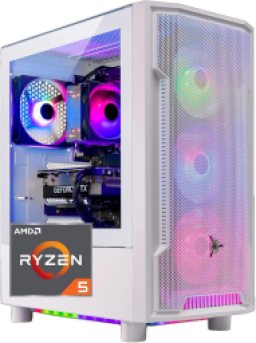
Skytech Archangel Gaming PC
GPU: NVIDIA GeForce RTX 3050 6GB (Dedicated) | CPU: AMD Ryzen 5 5500 3.6 GHz (4.2 GHz Turbo) | RAM: 16GB DDR4 3200 MHz | SSD Capacity: 1TB NVMe M.2 SSD
The Skytech Archangel is a real diamond in the rough if you're after a budget-friendly gaming desktop that still packs a punch. With its Ryzen 5 processor and RTX 3050 graphics card, it handles modern titles like a champ at 1080p, keeping frame rates smooth and gameplay crisp.
Setup is a breeze, and the sleek white case with glowing ARGB fans gives it just the right amount of flair without looking like a spaceship. While some users have mentioned occasional noise or rare hiccups out of the box, most agree it's a rock-solid performer for the price.
Alienware Aurora Gaming Desktop
Trusted Brand
GPU: NVIDIA GeForce RTX 5070 | CPU: Intel Core Ultra 7 265F | RAM: 32GB | SSD Capacity: 1TB
The Alienware Aurora Gaming Desktop is one of the best choices for hardcore gamers who want more customization and high performance. It boasts the advanced Intel Core Ultra 7 265F and an Nvidia GeForce RTX 5070 graphics card to handle power-intensive games and applications with ease.
It features a modern design with a matte-black finish, an optimized chassis, and customizable AlienFX lighting, including striking stadium lighting. Gamers will love the Alienware Command Center as it provides a single place to customize AlienFX lighting, monitor and adjust performance modes for different power states, and create custom profiles for every game. Plus, the hexagonal side vents improve airflow, resulting in smoother, quieter performance.
Designed for true gamers seeking an edge, the Alienware Aurora Gaming Desktop delivers everything needed for a superior gaming experience. With its minimalist design yet powerful graphics and system processor, it's a no-brainer for any gamer looking to upgrade their setup.
Skytech Gaming Shadow Gaming PC Desktop
GPU: NVIDIA GeForce RTX 4060 (8GB GDDR6X) | CPU: AMD Ryzen 7 5700X 3.4 GHz | RAM: 16GB | SSD Capacity: 1TB
The Skytech Shadow is an awesome value for the performance you get. The Ryzen 7 5700X paired with an RTX 4060 handles 1080p gaming with ease. The 16GB of DDR4 RAM keeps things responsive, and the 1TB NVMe SSD makes load times feel almost instant.
The tempered glass case, RGB fans and clean Windows 11 install give it a premium look without unnecessary clutter. Cooling also holds up well, thanks to the 240-millimeter AIO and solid airflow. You also get useful extras like Wi-Fi, multiple display outputs, and a keyboard and mouse, which makes setup simple.
On the other hand, some users have reported occasional shutdowns and minor inconsistencies in build quality or port layout. Since certain components can vary, it’s worth double-checking specs if specific ports or brands matter to you.
Overall, it’s a solid pick if you want a ready-to-go gaming PC that looks good and performs well for the price, as long as you’re OK with a bit of variability and potential upgrades down the line.
iBUYPOWER Slate MESH Gaming PC
GPU: NVIDIA GeForce RTX 5070 (12 GB) | CPU: Intel Core i7-14700F | RAM: 32GB DDR5 | SSD Capacity: 1TB
The iBUYPOWER Slate MESH is equipped with the Intel Core i7-14700F, paired with an RTX 5070 (12 GB) and 32GB of DDR5 RAM, allowing it to handle gaming, streaming and creative work without slowing down. Everything feels quick and responsive, even under heavier workloads. The 1TB NVMe SSD keeps load times short and gives you a solid amount of space for games and projects.
If you do any creative work, NVIDIA Studio support is a nice bonus for rendering and AI tasks. The overall package feels polished too. You get a tempered glass RGB case, included accessories, and solid cooling with a tower air cooler and multiple fans. However, noise levels can vary. Some systems stay quiet, while others get noticeably loud under load.
For most people, though, this is a strong plug-and-play option that combines performance and style. It’s a great fit if you want a powerful gaming and creative desktop without building it yourself.
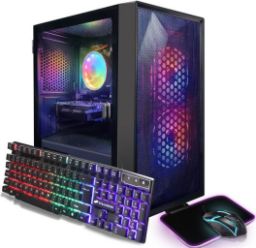
STGAubron Prebuilt Gaming PC Desktop
GPU: AMD Radeon RX 550 4GB GDDR5 | CPU: Intel Core i5 | RAM: 16GB | SSD Capacity: 512GB
The STGAubron packs a surprising amount of power into a budget-friendly desktop. The Intel Core i5, 16GB of RAM and 512GB SSD make everyday use feel quick and responsive. Boot times are fast, and basic multitasking is smooth. The AMD Radeon RX 550 (4GB) can handle lighter games at playable frame rates, making it a decent entry point for casual gaming.
It’s an easy system to get up and running, plus, you get RGB fans, a matching keyboard and a mouse. Cooling holds up well for typical use, and overall, it feels like a solid starter PC for someone coming from a laptop or older machine.
There are some clear limitations to keep in mind. The RX 550 is an entry-level GPU, so newer AAA games will require lower settings to run smoothly. It’s fine for casual gaming, but not built for high-end performance. Overall though, this is a good budget option for everyday use, light gaming and streaming.
CyberPowerPC Gamer Master
GPU: AMD Radeon RX 6500 XT | CPU: AMD Ryzen 5 5500 | RAM: 8GB DDR4 | SSD Capacity: 500GB
The CyberPowerPC Gamer Master is a solid entry-level gaming PC that gets the basics right. The AMD Ryzen 5 5500 and RX 6500 XT (4GB) handle 1080p gaming well, especially for esports and lighter titles. Everyday performance feels smooth, too, thanks to the fast 500GB PCIe NVMe SSD.
The tempered glass panel and RGB lighting give it a true gaming setup feel without driving up the price. You also get a wide range of ports, built-in Wi-Fi and Bluetooth, plus a keyboard and mouse to get started right away.
The biggest drawback is that the system only comes with 8GB of RAM and a 4GB GPU, which can start to feel tight in newer games or when multitasking. That said, it’s a good starting point if you’re on a budget and want something ready to go. With a few upgrades over time, it can grow into a much more capable system.
ASUS ROG GM700 Gaming Desktop
GPU: NVIDIA GeForce RTX 5070 | CPU: Intel Core Ultra 7 265F | RAM: 32GB DDR5 | SSD Capacity: 1TB
The ASUS ROG GM700 Gaming Desktop looks sharp and runs strong. You get a dual-glass case, Aura Sync lighting and a roomy 58L interior. It comes with a strong, modern setup. You get an Intel Core Ultra 7 processor and an RTX 5070 graphics card with 12GB of memory. There’s also 32GB of fast DDR5 RAM and a 1TB PCIe Gen4 SSD for storage.
In simple terms, it’s built to handle heavy workloads, smooth gaming, and quick load times without slowing down. The biggest downside is size. It's large and heavy, so desk space matters.
Overall, it's a strong machine with a nice design that's easy to upgrade; it's sure to hit a sweet spot for most.
Legion Tower 5i
GPU: NVIDIA GeForce RTX 5060 Ti | CPU: Intel Core Ultra 7 265F | RAM: 16GB DDR5 | SSD Capacity: 1TB
Overall, the Legion Tower 5i delivers strong, consistent performance without overcomplicating things. The Core Ultra 7 and RTX 5060 Ti handle 1440p gaming smoothly, with solid ray tracing and quick load times from the 1TB SSD.
It stays stable during long sessions, and the cooling keeps noise lower than you’d expect. Connectivity is solid, and the small extras like tool-less access and RGB earn it extra points.
The main downside is the starting memory. 16GB works, but heavier multitasking or creative work will push you to upgrade sooner. The one-year warranty is also shorter than some competitors.
Still, it’s a well-balanced system that offers good performance, easy upgrades, and features that make it great for daily use.
iBUYPOWER Y40 PRO Gaming PC
GPU: NVIDIA GeForce RTX 5070Ti 16GB | CPU: AMD Ryzen 9 7900X, 4.7 GHz | RAM: 32GB DDR5 | SSD Capacity: 2TB NVMe SSD
The iBUYPOWER Y40 PRO Gaming PC is built for high-end performance right out of the box. The Ryzen 9 7900X, RTX 5070 Ti and 32GB of DDR5 handle demanding games and heavy workloads without slowing down.
Load times are quick, thanks to the 2TB NVMe SSD, and multitasking feels smooth. The liquid cooling and RGB fans keep temperatures under control, while the case and included accessories give it a clean, ready-to-use setup.
The main concern is quality control. Some users report inconsistent performance and minor build issues, like gaps in the rear panel.
Still, it’s a strong plug-and-play option. You get serious power, modern features, and a polished setup.
Gaming desktop essentials: CPU and GPU
The lifeforce of your gaming desktop is its Central Processing Unit (CPU). How powerful it is will determine how well your machine performs. The power of your video card, or Graphics Processing Unit (GPU), affects the quality of the video and images you see on your screen. Technology advances every year, so you’ll want to find a machine that meets your needs now and one that could be upgraded later as needed.
CPU
The gaming PCs we recommend feature either AMD Ryzen or Intel Core processors, both of which offer strong performance for gaming. In recent years, AMD Ryzen chips have earned a reputation for excellent multitasking and value, especially in mid-range and high-end builds, while Intel CPUs often excel in single-core performance — a factor that still matters for some games. However, both brands are highly competitive, and real-world gaming performance is often very close, especially in the latest models.
For a smooth gaming experience, we suggest choosing a processor with at least four cores — labeled as "quad-core" — though many modern games and applications can take advantage of six or more cores. Opting for a CPU with higher core counts can also help your PC stay relevant as new, more demanding games are released.
Expert TIp
Microchip shortages have hit the graphics card industry especially hard–so you may want to invest in a machine with a higher-end video card while you can. While video card prices may go down in the future, any short-term upgrades to your video card will come with a decent wait.
BestReviews Electronics Expert
GPU
Gaming PCs are equipped with dedicated graphics cards — also called GPUs — that handle the demanding task of rendering video game graphics. Unlike integrated graphics, which are built into the CPU and designed for everyday tasks like browsing or streaming, a separate GPU significantly boosts performance for gaming and other graphics-intensive applications.
Most gaming GPUs are powered by chipsets from companies like NVIDIA or AMD. For example, you might see cards labeled as the NVIDIA GeForce GTX 1650, but these are manufactured by various brands such as ASUS, MSI, or Gigabyte, each offering their own cooling solutions and features. If a PC’s specifications list only integrated graphics and not a dedicated GPU, it means the system relies on the processor for graphics tasks — this usually results in noticeably weaker gaming performance and limits your options to less demanding or older games.
Gaming desktop memory
There are two types of memory you’ll need to look at when choosing a gaming desktop; both types play a role in the performance of the machine.
Storage (HDD or SSD)
This is basically how much storage space your computer has for games and files. If you’re a serious gamer and plan on downloading lots and lots of games, think big here. Increasing HDD storage is straightforward and can be done internally or externally. HDDs used to store more data than SSDs, but they were slower to access or load. However, most modern gaming desktops feature SSDs with storage capacities of 1 or 2TB, which is more than enough for most users.
RAM
Random access memory, or RAM, is your computer’s short-term memory. It temporarily stores data and files that your system and programs are actively using, so your computer can quickly retrieve information without waiting on the slower hard drive or SSD.
Having enough RAM is crucial for fast load times, smooth gameplay, and efficient multitasking; especially when running demanding games or switching between applications. If your PC runs low on RAM, it may slow down or struggle to keep up during intense gaming sessions.
Expert TIp
If you dislike the bold LED lighting that so many powerful gaming PCs come with, you can usually disable any internal lighting using software or by disconnecting the lights from the motherboard.
BestReviews Electronics Expert
Gaming desktop features
Tower design
Your tower or casing will house, protect, and preserve all your computer's main hardware components. Because gaming desktops are highly customizable, you’ll want to understand how to access your towers and where components are stored. Important units like fans and cooling systems rely on having the proper space within the tower, especially if they are being added on later.
Power supply
Keep an eye on your computer’s components and how much power they demand. A good power supply should provide enough energy for everything. For most gaming computers, you’ll need roughly 500 watts. As you add more parts, you’ll likely need to increase the power supply.
Compatibility
Your gaming desktop motherboard is where the internal components connect and communicate with each other. The motherboard plays a vital role in your machine’s potential to grow. Make sure that it can support all the hardware you think you’ll want, including memory slots and peripheral ports.
Cooling system
Gaming PCs are some of the most powerful computers on the market. Because of this, you’ll need to keep your system cool as it processes information. A cooling system is key to protecting your internal parts from overheating. Some cooling systems include multiple fans that are installed in the tower; others use more advanced solutions like liquid cooling. The size and construction of your system casing can help you determine which options are best.
Expert TIp
As you design your gaming rig, take ergonomics into consideration, especially for your back and wrists.
BestReviews Electronics Expert
Gaming desktop prices
Inexpensive
You can find a great starter system in the $800 to $1,000 range, but bear in mind that you’ll be limited to entry-level parts, such as processors and graphic cards. Also, note that a computer in this range would need to be upgraded in the future if you want to keep up with growing tech. Some budget options we like include the Skytech Archangel Gaming PC Desktop and STGAubron Prebuilt Gaming PC Desktop.
Mid-range
If you’ve got a bit more cash to spend, you can get yourself off to a good start and do a bit of future-proofing with $1,000 to $1,500. Look for a machine that focuses on solid processing power (quad-core to six-core) and a decent graphics card. Pricier components, such as expandable memory and additional drives, can be added later. Some of our favorite models in this price range include the Skytech Gaming Shadow Gaming PC Desktop and Lenovo Legion Tower 5i
Expensive
If you’re willing to spend $1,500 to $3,000 or more on a gaming desktop, you can get one of the most future-proof machines available. These gaming PCs are usually VR-ready and provide all the components needed to run the biggest and most complex games. They will also likely be able to support 4K and 5K gaming. Our favorites in this price range include the MSI Codex Z2 Gaming Desktop and Alienware Aurora Gaming Desktop.
Expert Tip
If you use a wireless mouse, switch to rechargeable batteries. You’ll always want a spare set around, and disposable batteries can get expensive.
BestReviews Electronics Expert
Tips
- When it comes to ports, USB Type-C ports are the way to go with a gaming desktop. These allow users to benefit from faster transfer speeds, and both are compatible with 4K or 5K monitoring.
- If you want the best gaming experience, connect your gaming desktop to a large monitor, not a TV. Though a television would work, it’s not the optimal choice due to refresh rates and latency issues.
- If you’re serious about PC gaming, you should consider having a multi-monitor setup. With more than one monitor, you enjoy a wider viewing range, and you can also use the setup to monitor important information like gaming maps (if the game allows), walkthrough information, and chat rooms while streaming.
How we analyzed
Gamers require desktops with sophisticated CPUs, graphics cards and other specs to ensure a stable, optimal gaming experience. We considered models with the latest processors, graphics cards and memory capabilities to provide gamers with multiple options for their primary gaming setup. Based on reviews, the best models offer high performance even during extended gaming sessions and offer plenty of customization to future-proofing.
FAQ
Q. Do all gaming desktops come with a keyboard and mouse?
A. Many gaming desktops are packaged with a compatible keyboard and mouse. While these devices would work adequately, a serious gamer may want to purchase a higher-quality keyboard and mouse to get the most out of their machine.
Q. Do gaming desktops play DVDs or Blu-ray?
A. Many, but not all, gaming PCs come with a DVD read/write drive. Since games today are often downloaded directly to the machine from the internet, however, you might not need this feature. If it turns out you want something like a Blu-ray player, you could always purchase it separately and install it yourself.
Q. Will most gaming desktops connect TVs?
A. Yes. Most modern gaming desktops are HDMI compatible, so as long as your TV or monitor has an HDMI input, you’ll be fine. Gaming desktops typically support display port connections as well, so most monitors are also compatible.
Our expertise
Jordan Hutchinson has been at BestReviews since 2021, and he now manages people and products for the testing lab. While he specializes in testing, Jordan also writes about trending tech topics. He has extensive knowledge of computers, TVs, speakers and other handheld electronics.
Kevin Luna has extensively tested and covered computers, from MacBooks to Chromebooks to gaming PCs, as a writer for BestReviews. He is knowledgeable about the differences between a high-end model and a midtier one and loves comparing their extensive feature sets. He has used several computers over the years and is familiar with the specs, features and functionality that determine overall performance.